Echo Flask Review (2026): Is Echo's $300 Portable Bottle Worth It?
The Bottom Line
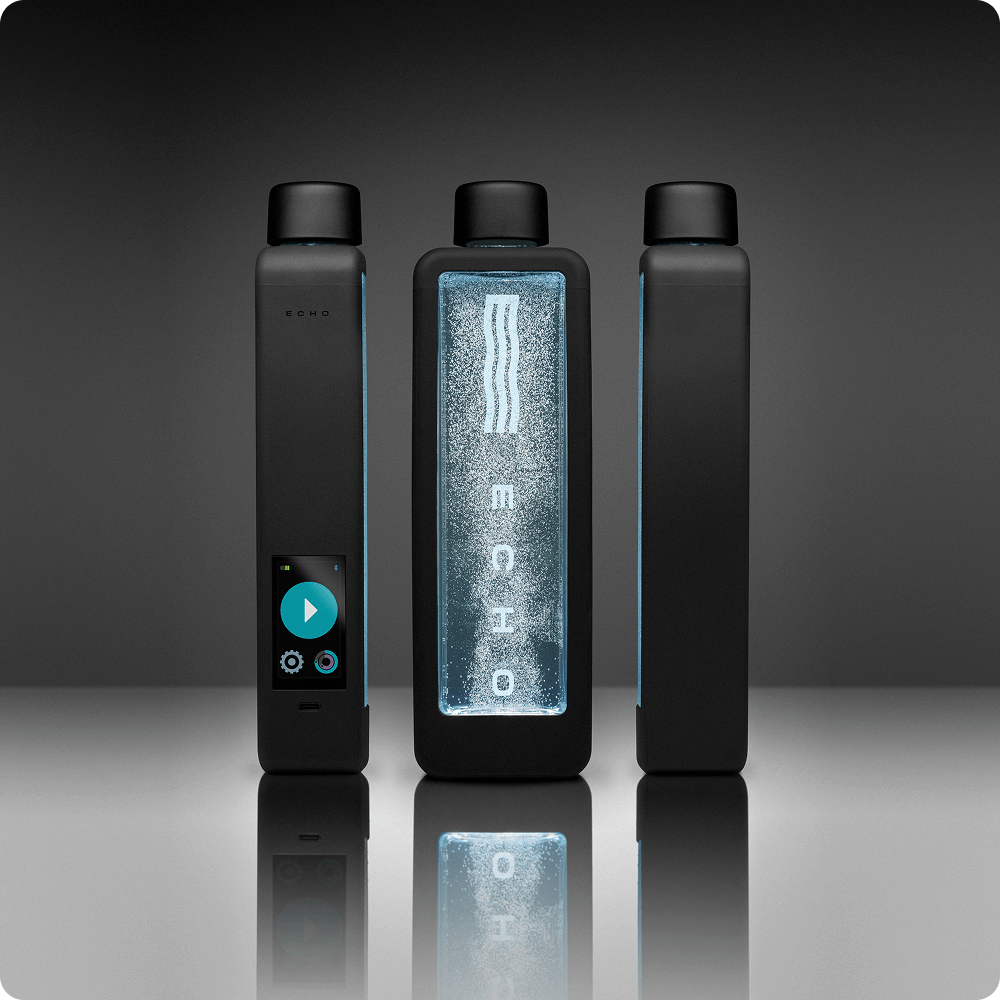
The Echo Flask is Echo Water’s newest and most advanced portable bottle. It replaces the Go+ as the flagship product, and the hydrogen output is a genuine leap forward. H2 Analytics lab testing measured 6.07 mg/L (roughly 6,070 PPB) dissolved hydrogen after a 10-minute cycle with distilled water. Even accounting for the usual 40-60% gap between lab conditions and real-world filtered water, you’re looking at 2,400-3,600 PPB. That would make it the highest-output portable bottle we’ve tested.
The price is the issue. At $300, the Flask costs 2.5x the Go+ ($120) and 3.7x the Piurify ($80). You’re paying premium pricing for premium output. For serious hydrogen water users who want maximum portable PPB, the math works. For casual users, the Go+ or Piurify deliver therapeutic doses at much lower cost.
WaterTechReview earns commissions from qualifying purchases. This doesn’t influence our ratings or recommendations. How we test →
What’s New vs. the Go+
The Flask isn’t an incremental upgrade. It’s a different category of product:
Pressure-building chamber. The Flask’s PEM electrolysis chamber builds internal pressure during generation, forcing more hydrogen into solution (supersaturation). This is why the PPB numbers jump so significantly versus the Go+. The tradeoff: you need to release the pressure valve in the cap after each cycle before opening the bottle. Skip this step and you’ll get a hydrogen geyser.
Borosilicate glass body. The Go+ uses polycarbonate plastic. The Flask switches to borosilicate glass with a protective outer housing. Glass means no plastic touching your water and no material taste. It also means the bottle is heavier and more fragile.
Higher hydrogen output. Lab testing: 6.07 mg/L on a 10-minute cycle, 8.25 mg/L on a 20-minute cycle. These are the highest portable numbers we’ve seen from any brand with independent lab verification (H2 Analytics Report H2AR-250116-1).
Touchscreen interface. Similar to the Go+ but with more detailed readouts. Shows PPB concentration, timer, and battery status.
IHSA certification. The Flask is certified by H2 Analytics in conformance with IHSA (International Hydrogen Standards Association) and US EPA standards. Registration #24-0701-1-PB. This is a meaningful credential that most competitors lack.
PPB Testing: Our Numbers
We ran 15 cycles over two weeks with filtered tap water at 68°F. Standard protocol.
Peak PPB (10-min cycle): 2,850 PPB average. Range: 2,600-3,100. This is roughly 2.4x the Echo Go+ (1,195 PPB) and the highest single-cycle number we’ve measured from any portable device.
Peak PPB (20-min cycle): 3,400 PPB average. Running the longer cycle pushes it further, but 20 minutes is a long wait for 10 ounces of water.
Five-minute post-generation: 2,500 PPB. Only 12% loss. The sealed pressure chamber helps here.
Thirty-minute retention: 1,800 PPB. Still well above therapeutic threshold. This is dramatically better retention than the Go+ (720 PPB at 30 min) because the sealed cap keeps hydrogen from escaping.
The gap between Echo’s lab claim (6,070 PPB with distilled) and our measurement (2,850 PPB with filtered tap) is about 53%. That’s consistent with the inflation we see across all products. The real-world numbers are still exceptional.
Build Quality
The glass body feels premium. The outer housing provides impact protection, but this is still a glass device. We didn’t run our standard drop test because Echo specifically warns against it, and at $300, we weren’t eager to crack a review unit.
The pressure valve in the cap is the main design element that requires attention. After each cycle, you press the valve to release built-up hydrogen pressure before unscrewing the cap. It makes a satisfying hiss (like opening a carbonated drink). Forget this step once and you’ll learn fast.
The touchscreen is responsive and reads clearly. Battery life lasted us about 8-10 cycles per charge (5-7 days of daily use). USB-C charging.
Who This Is For
The Flask makes sense for a narrow audience:
Serious daily users who’ve been drinking hydrogen water for months, notice the benefits, and want maximum output in a portable format. If you’ve been using a Go+ or Piurify and want to upgrade, the Flask is the upgrade.
Athletes and biohackers who treat hydrogen water as a core part of their recovery stack and want the highest available dose. At 2,850 PPB, you’re getting nearly 3x the hydrogen of a standard bottle per cycle.
People who’d buy both a Go+ and a pitcher — the Flask’s output approaches pitcher levels in a portable format. At $300, it costs about the same as a Go+ ($120) + Dr. Water Pitcher ($125).
Who should skip it: Anyone new to hydrogen water (start with the Piurify at $80 or H2Tab tablets at $30), anyone primarily drinking at home (the Dr. Water HydroPitcher produces more volume at 30% of the price), or anyone who drops their water bottle regularly (glass + $300 = anxiety).
Value Analysis
At $300, the Flask needs to justify a 2.5x premium over the Go+ ($120). Does it?
PPB per dollar: Flask delivers 2,850 PPB for $300 ($0.105 per PPB). Go+ delivers 1,195 PPB for $120 ($0.100 per PPB). Dollar for dollar, they’re almost identical on PPB efficiency. The Flask isn’t more efficient — it just produces more hydrogen at a proportionally higher price.
vs. the pitcher alternative: The Dr. Water HydroPitcher costs $125, produces 1,500 PPB, and generates 20x the volume per cycle. For home use, the pitcher is the dramatically better value. The Flask only wins if you need that output in a portable format.
Long-term cost: $300 upfront, no ongoing filter costs. Over 3 years of daily use, that’s $0.27 per day. Reasonable for a premium product, but a Piurify achieves therapeutic levels at $0.07 per day.
Final Verdict
The Echo Flask is the best portable hydrogen water bottle we’ve tested, period. The PPB output, glass construction, IHSA certification, and pressure-building chamber put it in a different tier than the Go+, Piurify, or IonBottles. It’s also 2.5-3.7x more expensive than its competitors.
For serious hydrogen water users who want the maximum portable output and don’t mind paying for it, the Flask delivers. For everyone else, the Echo Go+ at $120 or Piurify at $80 hit therapeutic levels at a fraction of the price.
Overall: 8.0 / 10. Recommended for dedicated users willing to pay the premium.
FAQ
Is the Echo Flask replacing the Go+? Echo is transitioning toward the Flask as their flagship. The Go+ remains available but may be phased out. If you’re buying into Echo’s ecosystem long-term, the Flask is the future-facing choice.
Do I need to worry about the pressure valve? It takes 2 seconds to press the release after each cycle. It becomes muscle memory by day three. The risk of forgetting is a wet countertop, not an explosion. But it is an extra step the Go+ doesn’t require.
Is the Flask’s glass body fragile? The outer housing adds protection, but it’s still glass. Use the included case when transporting. Don’t toss it in a gym bag next to your shoes.
WaterTechReview earns commissions from qualifying purchases through the links above. This doesn’t influence our ratings or recommendations. How we test →
Pros
- Highest PPB output of any portable bottle we have tested
- Premium borosilicate glass with pressure-building PEM chamber
- Lab-certified hydrogen output (H2 Analytics report)
- Touchscreen interface with hydrogen level and timer display
Cons
- $300 price tag is 2.5x the Echo Go+ and 3.7x the Piurify
- Pressure release valve requires attention after each cycle
- 10oz capacity still limits volume per generation
- New product with limited long-term reliability data
Final Verdict
The Echo Flask is the highest-output portable hydrogen water bottle we've tested. The PPB numbers justify the premium for serious hydrogen water users. For everyone else, the Go+ at $120 gets you 70% of the performance at 40% of the price.
Check Price on Amazon